
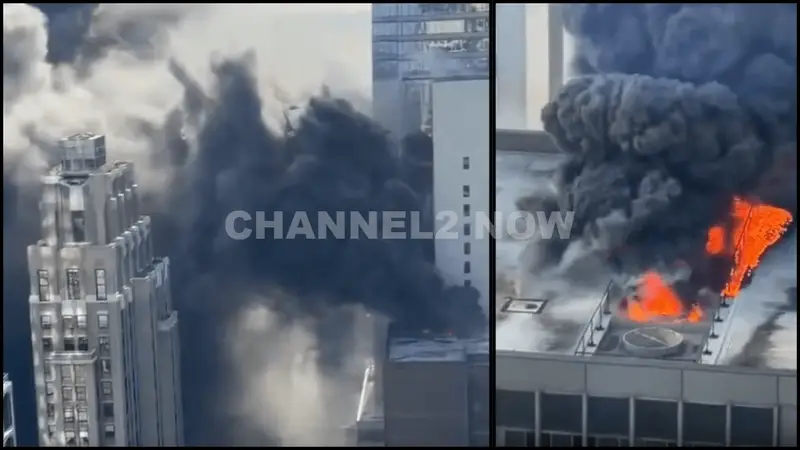
NEW YORK, N.Y. — The vibrant, celebratory energy of one of New York City’s most cherished holidays was violently and terrifyingly interrupted this morning by a towering column of thick, black smoke rising from the concrete canyons of Midtown. As hundreds of thousands of residents and tourists donned their green attire for the 265th annual St. Patrick’s Day Parade, the focus of the city shifted from the marching bands on Fifth Avenue to a life-threatening emergency just one block away.
The Fire Department of New York (FDNY) has officially confirmed a massive, high-rise rooftop fire in the vicinity of East 43rd Street and Madison Avenue.
The blaze, which erupted shortly before 10:00 a.m. on Tuesday, March 17, 2026, has sent a plume of acrid, dark smoke high above the Manhattan skyline, visible from as far away as the outer boroughs and New Jersey. The location of the fire is particularly critical, situated in a high-density commercial corridor just steps away from Grand Central Terminal and directly adjacent to the primary parade route.
As sirens wail through the crowded streets and FDNY crews execute a high-stakes aerial operation to contain the flames, the city is left in a state of nervous apprehension. This highly expansive, 2,000-word report delves deep into the harrowing timeline of the 10:00 a.m. 911 calls, the terrifying physical mechanics of a high-rise rooftop fire, the logistical nightmare of fighting fire amidst St. Patrick’s Day crowds, the impact on NYC transit, and the ongoing investigation into the cause of the blaze.
The Eruption of Crisis: 10:00 A.M. at 43rd and Madison
To fully comprehend the suddenness and the sheer, logistical magnitude of this emergency, one must understand the specific environment of Midtown Manhattan on St. Patrick’s Day. Madison Avenue is one of the world’s premier commercial arteries, and on March 17, the area is flooded with spectators, vendors, and tourists.
At approximately 9:55 a.m., the typical holiday chatter was replaced by the smell of burning rubber and plastic. Frantic 911 calls began pouring into the FDNY dispatch center, reporting “heavy black smoke and visible flames” erupting from the top of a high-rise structure near Grand Central.
In the high-stakes realm of urban firefighting, a “high-rise rooftop fire” is treated with extreme tactical urgency. The primary danger is not just the fire itself, but the potential for falling debris to strike crowds below and the risk of embers triggering secondary fires on adjacent historic structures.
The Mechanics of the Blaze: A Rooftop Inferno
Preliminary reports from FDNY officials suggest that the fire may have originated in the building’s mechanical systems, specifically the HVAC units or generator housing located on the rooftop. High-rise rooftops in Manhattan are often densely packed with cooling towers, electrical transformers, and telecommunications equipment—all of which serve as highly volatile fuel sources for a fire.
The “heavy black smoke” reported by thousands of witnesses is a secondary indicator of burning synthetic materials, likely insulation or petroleum-based components of the building’s infrastructure. FDNY units are utilizing high-rise standpipe systems and “tower ladders” to reach the elevation of the flames, while specialized squads navigate the interior stairwells to ensure the fire has not penetrated the upper residential or commercial floors.
Logistical Nightmare: Firefighting vs. The Parade
The timing of the fire could not be more challenging for New York’s first responders. With Fifth Avenue closed for the parade and Madison Avenue serving as a primary overflow and staging area, the movement of massive fire engines and ladder trucks is a harrowing exercise in precision.
Thousands of people gathered for the St. Patrick’s Day Parade initially believed the smoke was part of a celebratory display or a nearby construction project. However, as the FDNY arrived in force, the holiday mood shifted to one of concern. Police have been forced to establish a massive security perimeter, diverting foot traffic away from the 43rd Street corridor and creating a “sterile zone” for fire operations.
The Impact on Grand Central and Midtown Transit
Due to the proximity to Grand Central Terminal, the Metropolitan Transportation Authority (MTA) is on high alert. While train service inside the terminal has not been officially suspended, authorities are monitoring air quality levels as smoke drifts toward the ventilation systems of the underground complex. Commuters are being urged to utilize alternative entrances and avoid the Madison Avenue exits until the FDNY gives the “all-clear.”
Conclusion: A City Holds Its Breath
As of this afternoon, the FDNY has not reported any civilian or firefighter injuries, a testament to the rapid and professional response of New York’s Bravest. However, the fire remains “active,” and the cleanup and investigation phases are expected to last well into the evening.
The cause of the blaze remains under investigation by the FDNY Bureau of Fire Investigation. Whether it was a mechanical failure, a construction accident, or an electrical anomaly, the results have served as a somber reminder of the absolute vigilance required to protect the world’s most iconic skyline.
Leave a Reply